Friday, December 19, 2014

APOD 2.7

APOD 2.7
                Geminid Fireball over Mount Balang
See Explanation.  Clicking on the picture will download
 the highest resolution version available.
During the Geminid Meteor Shower, this image of a fireball burning over Mount Balang, China was captured. The background of the picture proudly displays the constellation Orion near the top right and Sirius (the brightest star in the night sky) can be seen in the center.The fireball in the lower right only lasted a fraction of a second and the fireball was created by a pebble that crossed Earth's atmosphere. This pebble was originally expelled by the Sun-orbiting asteroid-like object - 3200 Phaethon.

Monday, December 15, 2014

Johann H. Schroeter Works Cited

1. Complete Dictionary of Scientific Biography. Vol. 12. New York: Charles Scribner's Sons, 2008. Print.

2. "Johann Hieronymus Schroeter (1745-1816)." High Altitude Observatory, Education Pages, Sun 
                  Research, National Center for Atmospheric Research. N.p., n.d. Web. 15 Dec. 2014.

Recent Observations 11

Recent Observations 11
            On Saturday night, 12/13/14, I went outside (10:00 pm-11:00 pm) with a group of friends to watch the meteor shower. The sky was clear so we identified two constellations - Orion's belt and Gemini - in the sky and looked around that area to see the Geminid meteors falling. The meteors fell at different intervals and some were small with small trails, while others had trails that crossed the sky.

Friday, December 12, 2014

Recent Observations 10

Recent Observations 10
             The weather at night has become a lot colder however I still went out to observe the sky on Wednesday, 12/10/14. The moon was in a waning gibbous phase and I searched the sky for constellations. I was able to pin point the great square of Pegasus and identify Andromeda on the side of the square. The stars of fall have a magnitude that is difficult to observe from my yard so on a good night I am able to spot a couple constellations.

APOD 2.6

APOD 2.6
              Crystals on Mars
See Explanation.  Clicking on the picture will download
 the highest resolution version available.

The image above is a very zoomed in photo taken by the Mars Hand Lens Imager that is on the Curiosity rover. The picture shows what appears to be elongated crystals formed from the precipitation of minerals dissolved in water. This is thought to be the result of a river that had once flowed on the surface of Mars. The rock above was named Mojave (from the Pink Cliffs Outcrop of the Pahrump Hills-- base of Mt. Sharp) and the picture was lit up by LED lights.

Friday, December 5, 2014

Recent Observations 9

Recent Observations 9
            Looking up into the sky, Tuesday, 12/2/14, I was able to see the moon in a waxing gibbous phase. I was able to find Cepheus and the great square of Pegasus in the sky but it was difficult to find much due to the stars being so faint and the lights of my area obscuring the visibility of the stars within their constellations.

APOD 2.5

APOD 2.5
               Milky Way over Moon Valley 
See Explanation.  Clicking on the picture will download
 the highest resolution version available.


The picture above is an image of the Milky Way Galaxy above the Valle de la Luna in the Chilean Atacama desert. The picture was taken October 18th and it took five images to put together the panoramic view. In this picture, four other galaxies can be seen. To the far left of the panoramic, the Large and Small Magellanic Clouds are visible and to the right, beyond the Milky Way's central bulge, is the faint Andromeda Galaxy (2.5 million light-years away).

Friday, November 21, 2014

Recent Observations 8

Recent Observations 8
            The nights recently have been cloudy and cold. The moon on the night of 11/20/14 was in a waning crescent phase. I was able to find some circumpolar constellations, such as Ursa Minor and Cepheus. Also, using what I saw in Star Lab, i was able to find the great square of Pegasus.

APOD 2.4

APOD 2.4
                 Leonids Above Torre de la Guaita 
See Explanation.  Clicking on the picture will download
 the highest resolution version available.
During the morning of November 18, 1999, Europeans saw an increase in the number of meteors visible around 0210 UTC (counts growing up to 1000 per hour-- minimum amount for a "true meteor storm"). Observers, all over the world, saw between 30 and 100 meteors per hour. The picture is a 20-minute exposure and 5 Leonid meteors are seen clearly, as their tails blaze above the Torre de la Guaita (observation tower from 12th century--Girona, Spain). In 2014, over the span of the next few nights, the Leonids meteor shower will once again occur. However, this year the moon will be in a crescent (no skyglow) and Earth is thought to be passing through more debris left over from Comet Tempel-Tuttle than in 1999.

Friday, November 14, 2014

Recent Observations 7

Recent Observations 7
            On Monday, November 10, 2014, I went outside around 6:30. In my observations, I managed to point out some constellations and observe the moon in the Waning Gibbous phase. Around 6:42, I was able to observe an Iridium flare directly above me.

APOD 2.3

APOD 2.3
                Welcome to a Comet
See Explanation.  Clicking on the picture will download
 the highest resolution version available.
The Rosetta Mission lander has successfully landed on the surface of C67/P Churyumov-Gerasimenko. Philae's technology can be seen in the bottom left side of the image and the device bounced twice on the surface before settling near a shadowing wall (blocking some illumination that was destined to power Philae through the solar panels). All in all, the landing has gone as planned and information is being sent back during communication windows. 

Saturday, November 8, 2014

Recent Observations 6

Recent Observations 6

Recently I was able to observe the full moon in the sky. I have been using the Internet in an attempt to find fall constellations in the sky and may have spotted a few. Of course I was able to find Cepheus and Ursa Minor (given that they are circumpolar).

APOD 2.2

APOD 2.2

Sh2-155: The Cave Nebula 
The data in this photo were taken through narrowband filters (which track the glow of ionized sulfer, hydrogen and oxygen brand and displays this data in different hues). The cave is near Cepheus in appearance in the sky and it is 10 light years across (2400 away from Earth). The radiation is most likely causing the collapse of cores and well as new ones being created within.

Monday, October 27, 2014

The Great Star Count

The Great Star Count

                 I started by observing the summer triangle in the sky (Deneb, Altair, and Vega). From that point I spotted the northern cross in the sky. I am about two miles east of the interstate and from my back yard the pollution is low enough for me to be able to see magnitude 5 stars. According to the Great Star count website, by being able to see a V shape of stars at the northeast of Deneb, I am able to figure out that I can see about 1,700 stars on a clear night and I can see only a level of magnitude 5 stars from my back yard.

Sunday, October 26, 2014

APOD 2.1

APOD 2.1
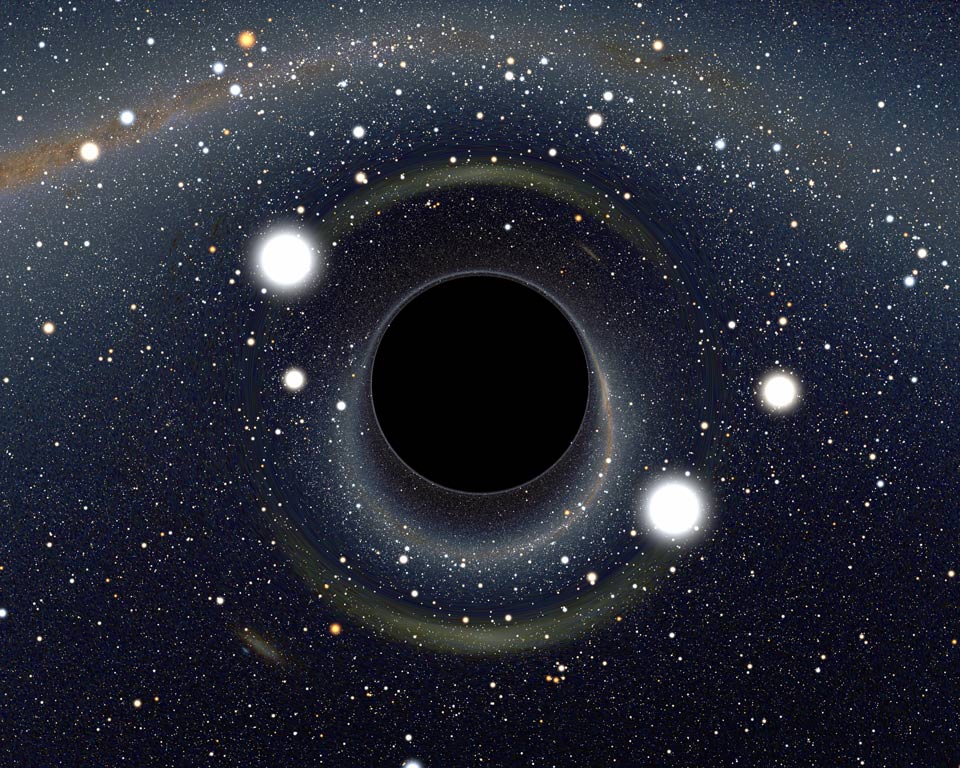
                  Too Close to a Black Hole
This image portrays a computer generated version of what a black hole may look like. The picture highlights how strange the image would come out, light bending around the strong gravity of the black hole (which causes the visual distortion). The image was taken from the 2MASS infrared sky survey and light from every direction is seen here, being bent and sent back to the viewer. Black holes are known as one of the densest states of matter.
See Explanation.  Clicking on the picture will download
 the highest resolution version available.

Recent Observations 5

Recent Observations 5
            I was able to see the waxing crescent moon on 10/25/2014. The sky was fully clear, not a cloud in sight. In this time, I was able to spot Polaris, and soon after Cepheus. After finding Cepheus, I was able to look to the side of it to spot Ursa Minor.

Friday, October 17, 2014

Recent Observations 4

Recent Observations 4

This morning showed off a extremely clear sky. The moon shined bright in its' phase of the waning crescent and I was able to see Jupiter nearing the moon in its' position in the sky. Nearby I also believe I saw the constellation Leo the Lion and its' brightest star Regulus. I was able to see this star by being up before dawn. I believe I was able to observe and find a few other constellations in the sky as well.

APOD 1.8

APOD 1.8
                 Rosetta's Selfie
See Explanation.  Clicking on the picture will download
 the highest resolution version available.

On October 7th, the Rosetta spacecraft not only took a picture of nearby comet 67P/Churyumov-Gerasimenko (about 16 kilometers away), but it also managed to take a picture of its' 14 meter long solar arrays. The comet has what is called a double-lobed nucleus, with dust and gas streaming away from it. The high contrast image was taken by a CIVA camera on the Philae lander, that is attached to the Rosetta spacecraft. This lander has a plan to soon land on the smaller lobe of the comet's nucleus, leaving the Rosetta on November 12 and snapping a picture of the orbiter before it leaves. The spacecraft is 472 million kilometers away from Earth! The high contrast image created is beautiful and I find it incredible how far technology has come. 

Thursday, October 9, 2014

Recent observations 3

Recent observations 3
                        Full moon
This morning when I looked up, the clouds finally cleared and I was able to see the sky. A beautiful full moon was displayed. Upon observation I was also able to find the North Star, Polaris, shining brightly in the sky. I was able to find some spots in the sky where I believe there was a constellation and hopefully the clouds clear up soon so I can see more.

APOD 1.7

APOD 1.7
                 Eclipse at Moonset 
I chose to blog about the lunar eclipse  that occurred Wednesday, October 8, because it was too cloudy for me to personally see it. In this image the curved shadow of Earth still cuts across the moon. The eclipse shined in the sky for almost an hour. For most areas within North America, especially the southern part of it, the lunar eclipse reached totality as it moved closer to the Western Hemisphere.

Wednesday, October 8, 2014

Nicolas Copernicus Biography

Nicolas Copernicus Biography


Nicolas Copernicus was an early Polish scientist that found Ptolemy's ancient astronomical work to be too complicated, leading to him to form his own theories which proved vital in creating the layout of the solar system we know today. He laid out the foundation that provided a support structure for other astronomers to build upon in the Copernican Revolution, such as Kepler's discovery of elliptical orbits. His many discoveries were responsible for giving Copernicus the title "the founder of modern astronomy". Nicolas Copernicus was born in Thorn, Poland on February 19, 1473. At the age of ten, his father died and he went to live with his uncle, Bishop of Varmia Lucas Watzenrode, where he stayed until he was eighteen years of age. At eighteen, Copernicus attended the University of Cracow to learn of painting and mathematics while preparing to work at the church with his uncle. Copernicus attended many universities, such as the University of Bologna, where he studied religious law while rooming with and aiding an astronomy professor (Domenico Maria de Novara); the University of Padua, where he went for medicine but never graduated; and the University of Ferrara, which was the location of where he took the cannon law test to take his place in the church (he remained a canon of the church his whole life).

 Copernicus' earliest recorded observation was on March 9, 1497 and by the time March 31, 1513 rolled around, he had constructed a small roofless tower in Frauenburg, Poland, in order to view the sky. All of Copernicus' observations were made with the naked eye, only aided by three instruments; a parallactic instrument to observe the moon, a quadrant for the sun, and an armillary sphere to study the stars. His first work was De hypothesibus motuum coelestium a se constitutis commentarioulus and in this composition, Copernicus challenged Earth being the center of the universe, believe that instead, it was the sun in the center (heliocentric model) and the stars were at the outermost limit of the universe. He believed that Earth's rotation was responsible for the rising and setting of the sun, the movement of the stars, and the cycles of the four seasons. Copernicus also believed that Earth's motion through space was the cause of the retrograde motion of the planets as seen when observing the sky from Earth. His first official work was Commentariolus or the "Little Commentary". Copernicus described the span of the universe to be "similar to the infinite" rather than choosing one particular side, leaving that solution to be found by other astronomers. Earth's "motion of declination" was stated in his works and Nicolas Copernicus believed that the axis Earth rotates on meets the firmament at the celestial poles. In between the two celestial poles, was the celestial equator. Copernicus named the plane that cut the celestial sphere in the ecliptic orbit of the sun the "grand circle". On June 1542, he composed his final ideas in his second book, Derevolutionibus orbium coelestium (Revolutions of the Heavenly Spheres); in which, he mentioned two Pythagoreans in: Philolaus' idea that Earth orbits and imaginary central fire, and Ecphantus' idea that Earth is on an axial rotation. After his death on May 24, 1543, Derevolutionibus orbium coelestium was banned by the Catholic Church.

            Despite not having the technology to prove his theories, Copernicus was an important factor in developing modern astronomy and kick starting a hunger for the true answers of the universe in the Copernican Revolution.  Copernicus disputed conventional wisdom and his work later upset the Church and composed groundbreaking science that we use to this day. 

Friday, October 3, 2014

Recent Observations 2

Recent Observations 2

On Wednesday night, I went outside around eight pm and stayed out observing the sky until nine pm. The sky was not fully clear but it was clear enough for me to see some of the stars. I observed the moon in it's first quarter of it's set of phases. When I looked over to the right, I was able to observe Mars and Antares as they appeared very close in their positions in the sky (about a fist away from each other).

APOD 1.6

APOD 1.6
                 A Full Circle Rainbow over Australia 
See Explanation.  Clicking on the picture will download
 the highest resolution version available.

Your average rainbow is generally perceived as the top half, a well known arch. The real reason this happens is because directions toward and nearer to the ground have fewer raindrops. When viewed from the sky, the full rainbow can be seen. The image above was taken by a helicopter around Cottesloe Beach (near Perth, Australia). This particular picture was taken between the setting sun and a downpour. Capturing this image is a true rarity because, in order to see this phenomenon, there must be an internal reflection of sunlight by the raindrops. The image also features a second, fainter, full rainbow as a bonus as well.

Friday, September 26, 2014

Nicolas Copernicus Biography Sources

1. Complete Dictionary of Scientific Biography. Vol. 3. New York: Charles Scribner's Sons, 2008. 401-11. 
Print.

2. "Nicolaus Copernicus." Bio. A&E Television Networks, 2014. Web. 26 Sep. 2014.

3. "Nicolaus Copernicus Biography: Facts & Discoveries." Space.com. N.p., n.d. Web. 26 Sept. 2014.

APOD 1.5

APOD 1.5
                   Saturn at Equinox 
See Explanation.  Clicking on the picture will download
 the highest resolution version available.
I choose to read about Saturn at the equinox because the picture drew me in. It is incredible that something so large can be projected as something that seems so small. It took a digital composite of 75 images to create this image. Every 15 years Saturn's rings point towards Earth, creating an illusion of the rings disappearing. Saturn's rings are so thin that when this event occurs, a visual from Earth displays an edge on appearance. However; the image displayed was taking from an orbiting spacecraft, called Cassini.  

Friday, September 19, 2014

APOD 1.4

APOD 1.4
                Potentially Habitable Moons 
See Explanation.  Clicking on the picture will download
 the highest resolution version available.

I choose to view this article because the thought of another possible home for human survival is incredible, a sy-fy movie come true. Upon reading the page, I learned that a mission, called the Galileo Mission, to Jupiter, lead to the discovery of ocean of liquid waters and signs of Ganymede's interior seas. In the case of Enceladus, one of Saturn's moons, the Cassini probe discovered erupting fountains of water ice. Looking into Titan, the large moon covers up surface lakes of frigid but still liquid hydrocarbons with it's dense atmosphere. These sources of water is what in vital in the survival of life. All these facts have lead researchers to believe that there is more habitable exomoons than there are exoplanets.

Tuesday, September 16, 2014

Recent Observations

Although the nights have often been very cloudy due to the weather, I have managed to observe some astrological events over the past few weeks. The first of these events being Venus and Mars passing each other in close proximity. This occurred over the course of many days, as the planets began to once more move apart. I have also been observing the moon in the mornings before I attend school. I have watched the moon transform from a waning gibbous to the third quarter moon, and then to a waning crescent. The light reflected off the moon is becoming less visible as the shadow takes over, soon the phase will become a new moon.

Friday, September 12, 2014

APOD 1.3

APOD 1.3
                 An Aurora Cupcake with a Milky Way Topping 
                    See Explanation.  Clicking on the picture will download
 the highest resolution version available.
I chose this article because I, personally, find the Aurora light shows amazing and hope to see it in person one day. When reading over the article I found that double auroral ovals were seen over Sweden. The auroral ovals were topped off with the central band of our Milky Way galaxy, making the whole image look like a rainbow cupcake. I learned that auroras are caused by our sun ejecting plasma clouds into the Solar System (in this case, it happened a few days before), thus ending in ionized particles subsequently impacted the magnetosphere of Earth. The article ended off on an active sunspot group, which out of curiosity, I clicked to follow. The page I was redirected to was from August 1, 2002. One that page, reports of sunspot clusters that were about thirty times the diameter of Earth were displayed and I learned that individual sunspots are not cataloged but group clusters of sunspots are. 
                                  See Explanation.  Clicking on the picture will download
 the highest resolution version available.

Friday, September 5, 2014

APOD 1.2

APOD 1.2
                      M6: The Butterfly Cluster

I chose to review this article because the butterfly cluster appears in the constellation, Scorpius. This swayed my decision into selected it because my zodiacal sign is Scorpius. When I read the page, I learned not only of the cluster's nick name but also the scientific number assigned to it, NGC 6405. It's distance is 20,000 light years away and has a 20 light year span. The 100 million year old cluster is composed mainly of young blue stars, such as most clusters apparently are. I decided to follow up on young blue stars. By clicking the link I ended up on a post from October 14, 2009. The page discussed another cluster called Pleiades (also known as the seven sisters or M45). It is known a blue reflection nebulae. This is because although they are not related, the stars and a cosmic dust cloud cross paths in space, creating the appearance that the seven sisters have.

Monday, September 1, 2014

APOD 1.1

APOD 1.1
                  Milky Way Over Yellowstone

I chose to read about this particular article due to my recent summer trip to Yellowstone, Wyoming. While reading the article, many things I saw I had already learned from that trip. By clicking to learn more about the central band of the Milky Way, it took me to a page that had been written on July 10, 2011. After reading that page I followed a link to dark dust lanes (a July 8,2009 post) and I learned that dark dust lanes are caused by dust obscuring the starlight, as well as, the fact that dark dust lanes are formed of hydrogen and molecular gas.