The Great Star Count
I started by observing the summer triangle in the sky (Deneb, Altair, and Vega). From that point I spotted the northern cross in the sky. I am about two miles east of the interstate and from my back yard the pollution is low enough for me to be able to see magnitude 5 stars. According to the Great Star count website, by being able to see a V shape of stars at the northeast of Deneb, I am able to figure out that I can see about 1,700 stars on a clear night and I can see only a level of magnitude 5 stars from my back yard.
Monday, October 27, 2014

Sunday, October 26, 2014
APOD 2.1
APOD 2.1
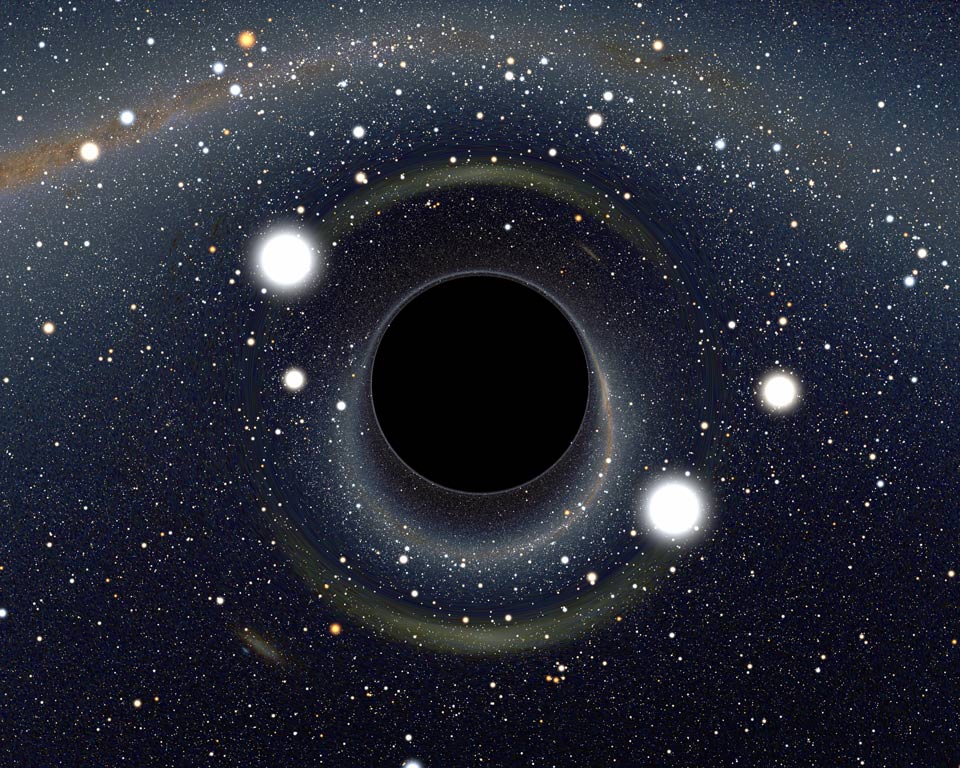
Too Close to a Black Hole
This image portrays a computer generated version of what a black hole may look like. The picture highlights how strange the image would come out, light bending around the strong gravity of the black hole (which causes the visual distortion). The image was taken from the 2MASS infrared sky survey and light from every direction is seen here, being bent and sent back to the viewer. Black holes are known as one of the densest states of matter.
Recent Observations 5
Recent Observations 5
I was able to see the waxing crescent moon on 10/25/2014. The sky was fully clear, not a cloud in sight. In this time, I was able to spot Polaris, and soon after Cepheus. After finding Cepheus, I was able to look to the side of it to spot Ursa Minor.
I was able to see the waxing crescent moon on 10/25/2014. The sky was fully clear, not a cloud in sight. In this time, I was able to spot Polaris, and soon after Cepheus. After finding Cepheus, I was able to look to the side of it to spot Ursa Minor.
Friday, October 17, 2014
Recent Observations 4
Recent Observations 4
This morning showed off a extremely clear sky. The moon shined bright in its' phase of the waning crescent and I was able to see Jupiter nearing the moon in its' position in the sky. Nearby I also believe I saw the constellation Leo the Lion and its' brightest star Regulus. I was able to see this star by being up before dawn. I believe I was able to observe and find a few other constellations in the sky as well.
This morning showed off a extremely clear sky. The moon shined bright in its' phase of the waning crescent and I was able to see Jupiter nearing the moon in its' position in the sky. Nearby I also believe I saw the constellation Leo the Lion and its' brightest star Regulus. I was able to see this star by being up before dawn. I believe I was able to observe and find a few other constellations in the sky as well.
APOD 1.8
APOD 1.8
Rosetta's Selfie

On October 7th, the Rosetta spacecraft not only took a picture of nearby comet 67P/Churyumov-Gerasimenko (about 16 kilometers away), but it also managed to take a picture of its' 14 meter long solar arrays. The comet has what is called a double-lobed nucleus, with dust and gas streaming away from it. The high contrast image was taken by a CIVA camera on the Philae lander, that is attached to the Rosetta spacecraft. This lander has a plan to soon land on the smaller lobe of the comet's nucleus, leaving the Rosetta on November 12 and snapping a picture of the orbiter before it leaves. The spacecraft is 472 million kilometers away from Earth! The high contrast image created is beautiful and I find it incredible how far technology has come.
Rosetta's Selfie
On October 7th, the Rosetta spacecraft not only took a picture of nearby comet 67P/Churyumov-Gerasimenko (about 16 kilometers away), but it also managed to take a picture of its' 14 meter long solar arrays. The comet has what is called a double-lobed nucleus, with dust and gas streaming away from it. The high contrast image was taken by a CIVA camera on the Philae lander, that is attached to the Rosetta spacecraft. This lander has a plan to soon land on the smaller lobe of the comet's nucleus, leaving the Rosetta on November 12 and snapping a picture of the orbiter before it leaves. The spacecraft is 472 million kilometers away from Earth! The high contrast image created is beautiful and I find it incredible how far technology has come.
Thursday, October 9, 2014
Recent observations 3
Recent observations 3
Full moon

Full moon
This morning when I looked up, the clouds finally cleared and I was able to see the sky. A beautiful full moon was displayed. Upon observation I was also able to find the North Star, Polaris, shining brightly in the sky. I was able to find some spots in the sky where I believe there was a constellation and hopefully the clouds clear up soon so I can see more.
APOD 1.7
APOD 1.7
Eclipse at Moonset
I chose to blog about the lunar eclipse that occurred Wednesday, October 8, because it was too cloudy for me to personally see it. In this image the curved shadow of Earth still cuts across the moon. The eclipse shined in the sky for almost an hour. For most areas within North America, especially the southern part of it, the lunar eclipse reached totality as it moved closer to the Western Hemisphere.
Wednesday, October 8, 2014
Nicolas Copernicus Biography
Nicolas Copernicus Biography
Nicolas Copernicus was an early
Polish scientist that found Ptolemy's ancient astronomical work to be too
complicated, leading to him to form his own theories which proved vital in
creating the layout of the solar system we know today. He laid out the foundation
that provided a support structure for other astronomers to build upon in the
Copernican Revolution, such as Kepler's discovery of elliptical orbits. His
many discoveries were responsible for giving Copernicus the title "the
founder of modern astronomy". Nicolas Copernicus was born in Thorn ,
Poland February 19, 1473 . At the age of ten,
his father died and he went to live with his uncle, Bishop of Varmia Lucas
Watzenrode, where he stayed until he was eighteen years of age. At eighteen,
Copernicus attended the University of
Cracow
Copernicus' earliest recorded observation was
on March 9, 1497 and by the time March 31, 1513 rolled around, he had constructed
a small roofless tower in Frauenburg, Poland, in order to view the sky. All of
Copernicus' observations were made with the naked eye, only aided by three
instruments; a parallactic instrument to observe the moon, a quadrant for the
sun, and an armillary sphere to study the stars. His first work was De hypothesibus motuum coelestium a se
constitutis commentarioulus and in this composition, Copernicus challenged
Earth being the center of the universe, believe that instead, it was the sun in
the center (heliocentric model) and the stars were at the outermost limit of
the universe. He believed that Earth's rotation was responsible for the rising
and setting of the sun, the movement of the stars, and the cycles of the four
seasons. Copernicus also believed that Earth's motion through space was the
cause of the retrograde motion of the planets as seen when observing the sky
from Earth. His first official work was Commentariolus
or the "Little Commentary". Copernicus described the span of the
universe to be "similar to the infinite" rather than choosing one
particular side, leaving that solution to be found by other astronomers. Earth's
"motion of declination" was stated in his works and Nicolas
Copernicus believed that the axis Earth rotates on meets the firmament at the
celestial poles. In between the two celestial poles, was the celestial equator.
Copernicus named the plane that cut the celestial sphere in the ecliptic orbit
of the sun the "grand circle". On June 1542, he composed his final
ideas in his second book, Derevolutionibus
orbium coelestium (Revolutions of the Heavenly Spheres); in which, he
mentioned two Pythagoreans in: Philolaus' idea that Earth orbits and imaginary
central fire, and Ecphantus' idea that Earth is on an axial rotation. After his
death on May 24, 1543 , Derevolutionibus orbium coelestium was
banned by the Catholic Church.
Despite
not having the technology to prove his theories, Copernicus was an important
factor in developing modern astronomy and kick starting a hunger for the true
answers of the universe in the Copernican Revolution. Copernicus disputed conventional wisdom and
his work later upset the Church and composed groundbreaking science that we use
to this day.
Friday, October 3, 2014
Recent Observations 2
Recent Observations 2
On Wednesday night, I went outside around eight pm and stayed out observing the sky until nine pm. The sky was not fully clear but it was clear enough for me to see some of the stars. I observed the moon in it's first quarter of it's set of phases. When I looked over to the right, I was able to observe Mars and Antares as they appeared very close in their positions in the sky (about a fist away from each other).
On Wednesday night, I went outside around eight pm and stayed out observing the sky until nine pm. The sky was not fully clear but it was clear enough for me to see some of the stars. I observed the moon in it's first quarter of it's set of phases. When I looked over to the right, I was able to observe Mars and Antares as they appeared very close in their positions in the sky (about a fist away from each other).
APOD 1.6
APOD 1.6
A Full Circle Rainbow over Australia

Your average rainbow is generally perceived as the top half, a well known arch. The real reason this happens is because directions toward and nearer to the ground have fewer raindrops. When viewed from the sky, the full rainbow can be seen. The image above was taken by a helicopter around Cottesloe Beach (near Perth, Australia). This particular picture was taken between the setting sun and a downpour. Capturing this image is a true rarity because, in order to see this phenomenon, there must be an internal reflection of sunlight by the raindrops. The image also features a second, fainter, full rainbow as a bonus as well.
A Full Circle Rainbow over Australia
Your average rainbow is generally perceived as the top half, a well known arch. The real reason this happens is because directions toward and nearer to the ground have fewer raindrops. When viewed from the sky, the full rainbow can be seen. The image above was taken by a helicopter around Cottesloe Beach (near Perth, Australia). This particular picture was taken between the setting sun and a downpour. Capturing this image is a true rarity because, in order to see this phenomenon, there must be an internal reflection of sunlight by the raindrops. The image also features a second, fainter, full rainbow as a bonus as well.
Subscribe to:
Posts (Atom)